
Uniquement disponible en anglais.
– Papier (Collections classiques, Encyclopédie SCIENCES) :
Délai de livraison : environ deux semaines
Envois uniquement vers : France métropolitaine, Belgique, Suisse et Luxembourg
Impression en couleur
Un ebook de l’ouvrage (à l’exception des titres de l’Encyclopédie SCIENCES) est offert pour tout achat
de sa version papier sur notre site, il vous sera envoyé après la finalisation de votre commande
Offre non applicable aux librairies
– Ebook (Collections classiques, Encyclopédie SCIENCES, Abrégés) :
Prix réservé aux particuliers
Pour les institutions : nous contacter
Nos ebooks sont au format PDF (compatible sur tout support)
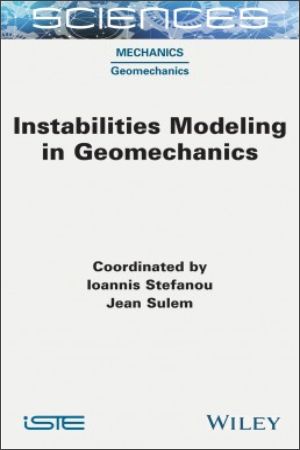
Instabilities Modeling in Geomechanics describes complex mechanisms which are frequently met in earthquake nucleation, geothermal energy production, nuclear waste disposal and CO2 sequestration. These mechanisms involve systems of non-linear differential equations that express the evolution of the geosystem (e.g. strain localization, temperature runaway, pore pressure build-up, etc.) at different length and time scales.
In order to study the evolution of a system and possible instabilities, it is essential to know the mathematical properties of the governing equations. Therefore, questions of the existence, uniqueness and stability of solutions naturally arise.
This book particularly explores bifurcation theory and stability analysis, which are robust and rigorous mathematical tools that allow us to study the behavior of complex geosystems, without even explicitly solving the governing equations. The contents are organized into 10 chapters which illustrate the application of these methods in various fields of geomechanics.
1. Multiphysics Role in Instabilities in Geomaterials: a Review, Tomasz Hueckel.
2. Fundamentals of Bifurcation Theory and Stability Analysis, Ioannis Stefanou and Sotiris Alevizos.
3. Material Instability and Strain Localization Analysis, Jean Sulem.
4. Experimental Investigation of the Emergence of Strain Localization in Geomaterials, Pierre Bésuelle.
5. Numerical Modeling of Strain Localization, Panos Papanastasiou and Antonis Zervos.
6. Numerical Modeling of Bifurcation: Applications to Borehole Stability, Multilayer Buckling and Rock Bursting, Euripides Papamichos.
7. Numerical Modeling of Multiphysics Couplings and Strain Localization, Frédéric Collin, Panagiotis Kotronis and Benoît Pardoen.
8. Multiphysics Couplings and Strain Localization in Geomaterials, Jean Sulem and Ioannis Stefanou.
9. On the Thermo-poro-mechanics of Chemically Active Faults, Manolis Veveakis.
10. Analysis of Instabilities in Faults, Hadrien Rattez, Ioannis Stefanou, Jean Sulem, Manolis Veveakis and Thomas Poulet.
Ioannis Stefanou
Ioannis Stefanou is Professor at ECN, France, and leads several geomechanics projects. His main research interests include mechanics, geomechanics, control, induced seismicity and machine learning.
Félix Darve
Félix Darve is Emeritus Professor at the Soils Solids Structures Risks (3SR) laboratory, Grenoble-INP, Grenoble Alpes University, France. His research focuses on computational geomechanics.


